How to Check Unpaid Property Taxes on a Foreclosed Property
Unpaid property taxes usually survive a foreclosure. Learn how to check the collector record, tax certificates, municipal charges and servicer payments before you buy.
Scalance Global
On this page
- Key Takeaways
- Why Unpaid Taxes Matter More on a Foreclosed Home
- Step 1: Pin Down the Parcel Number and Every Taxing Body
- Step 2: Read the Treasurer or Tax Collector Record Carefully
- Step 3: Look for Tax Certificates, Sold Liens and Pending Tax Deeds
- Step 4: Check Special Assessments, Utility Charges and Municipal Liens
- Step 5: Find Out Whether the Servicer Paid the Taxes
- Step 6: Get an Official Tax Statement Before Closing
- How the Way You Buy Changes Who Pays
- When the Numbers Do Not Add Up
- When to Hand the Search to a Professional
- Frequently Asked Questions
- Conclusion
To check unpaid property taxes on a foreclosed property, get the parcel number from the county assessor, then pull the tax record from the county treasurer or tax collector for the current year and every prior year. Look for delinquent installments, penalties, sold tax certificates and any pending tax deed application. Then check city and district charges that never appear on the county bill. Before you close, get an official tax statement with a good-through date, because the amount owed on a delinquent parcel changes every month.
Key Takeaways
Unpaid taxes are one of the few debts that usually stay with a foreclosed home no matter who owned it before. Keep these points in mind.
Property tax liens generally rank ahead of mortgages, so a mortgage foreclosure does not erase them.
The treasurer or tax collector, not the assessor, is the office that shows what has actually been paid.
In tax certificate states, someone else may already hold a lien on the parcel and be counting down to a tax deed.
City utility charges, special assessments and code liens can sit outside the county tax bill.
A servicer may have paid the taxes during the default, which changes what you find on the record.
An official tax statement dated close to closing is the only figure worth relying on.
The steps below work for a home bought at auction, from a bank's REO inventory or from a homeowner who is about to lose it. Tax rules vary by state and county, so confirm local practice for the parcel you are reviewing.
Why Unpaid Taxes Matter More on a Foreclosed Home
A homeowner who stops paying the mortgage often stops paying everything else too. When the loan had an escrow account, the servicer may keep paying taxes for a while. When it did not, the bills simply pile up. Either way, a foreclosed property is far more likely than an ordinary resale to carry a tax problem.
The bigger issue is priority. As Cornell's Legal Information Institute explains in its definition of a tax lien, when a property is mortgaged, the tax lien takes precedence over the mortgage. A foreclosure wipes out liens junior to the loan being foreclosed. Property taxes are usually senior to it, so they survive and follow the property to the next owner. Our guide to foreclosure liens, records and ownership walks through which other liens survive a sale and which do not.
That is why a tax check is not a box to tick at the end. It belongs at the start of the review, next to the other records to check before a foreclosure auction, because the answer can change what the property is worth to you.
Step 1: Pin Down the Parcel Number and Every Taxing Body
Every tax search starts with the parcel number, sometimes called the APN, PIN or folio number. You can find it on the county assessor's website or on the last recorded deed. Searching by address alone is risky, because addresses get misspelled and split when lots are divided.
Check whether the home sits on more than one parcel. A house with a side lot or a condo with a deeded parking space may have two or three tax bills, and each one needs its own search.
Next, find out who levies taxes on the property. In many places the county collects for the school district, the city and special districts on one bill. Elsewhere a city, township or fire district bills on its own schedule. Our property tax calculator can help you estimate a normal annual bill so you can tell when a balance looks too high or too low.
Step 2: Read the Treasurer or Tax Collector Record Carefully
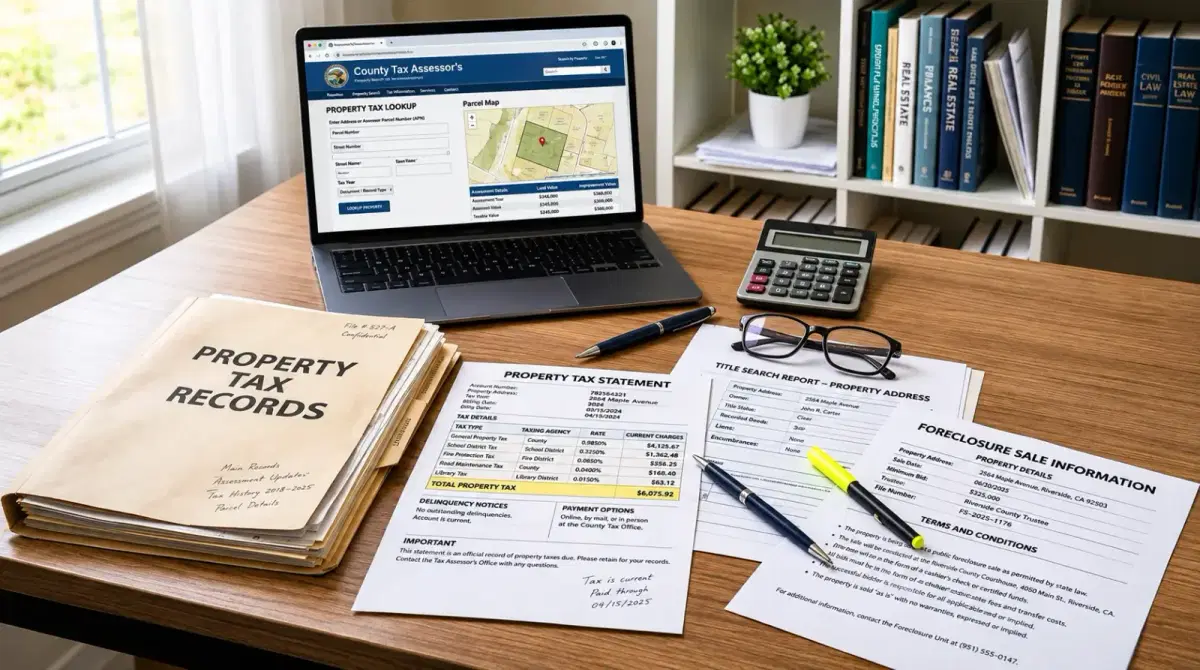
The assessor values the property. The treasurer or tax collector bills and collects. Only the collector's record shows what has been paid, what is late and what penalties have been added, so that is the record you need.
Most collector websites show the current tax year by default. Look for a link to prior years or a delinquent tax search, and work back several years. A foreclosure that took two or three years to finish can leave a matching string of unpaid years behind it. Note the installment due dates, the amount of each installment, any penalty or interest, and whether a payment is marked partial or pending.
Florida gives a clear example of how these dates work. Under Florida's tax certificate redemption statute and the related sections of Chapter 197, taxes are due on November 1 and become delinquent on April 1 of the following year, or later if the tax notice went out late. Other states use different dates, installment schedules and penalty rates, so always read the dates on the collector's own page rather than assuming.
Watch for warning signs. A balance that suddenly jumps can mean an exemption was removed. A note such as "certificate sold" or "subject to tax sale" means the problem is already bigger than a late bill.
Step 3: Look for Tax Certificates, Sold Liens and Pending Tax Deeds
When a bill stays unpaid, the county does not just wait. Depending on the state, it may sell a tax lien certificate to an investor, hold the lien itself, or move toward a tax deed sale. In a certificate state, someone else may already hold a lien on the home and be earning interest while you look.
Florida again shows how this works in practice. The holder of a tax certificate can apply for a tax deed once two years have passed since April 1 of the year the certificate was issued. Anyone can redeem the certificate before a tax deed is issued by paying the face amount plus interest, costs and charges, and the statute sets a minimum interest charge of 5 percent on most certificates. A buyer who does not redeem in time can lose the property to a tax deed sale, and our tax lien calculator shows how fast interest grows on an unredeemed certificate.
To check this, search the collector's certificate or tax sale records by parcel, not just the bill. Note the certificate number, the year it was sold, the holder and the redemption amount. Then search for any tax deed application, which in many counties shows up on the clerk's website rather than the collector's.
If you want to understand the investor side of these sales, our guide to tax lien investing due diligence and our post on tax deed investing explain what the certificate holder is looking at.
Step 4: Check Special Assessments, Utility Charges and Municipal Liens
Plenty of charges that act like taxes never make it onto the county tax bill. Special assessments for sidewalks, sewers or street lights may be billed separately or spread over many years. Some cities can record unpaid water and sewer bills as liens. Code enforcement fines, demolition costs, board-up charges and weed or trash abatement fees are common on vacant foreclosed homes, because the city often stepped in while nobody was looking after the place.
Each of these lives in a different office. Start with the city or township clerk, then the utility department and the code enforcement office. Some municipalities issue a municipal lien certificate that lists everything open against the parcel. If the home was vacant, ask about unpaid vacant property registration fees too.
These charges are easy to miss and slow to resolve, which is one reason buyers and lenders order property tax services that cover municipal and special district records along with the county bill.
Step 5: Find Out Whether the Servicer Paid the Taxes
A clean tax record on a foreclosed home does not always mean the borrower paid. Mortgage servicers often pay delinquent taxes during a default to protect the loan's position, because a tax lien would otherwise jump ahead of the mortgage. The servicer then adds what it paid to the debt it is trying to recover.
For a buyer, this cuts both ways. If the servicer paid, the parcel may be current even though the owner paid nothing for years. If the servicer stopped, perhaps because the foreclosure stalled, the delinquency can be larger than you expect. Many collector websites show who made each payment, and a name like a loan servicer or a tax service company tells you a lot about the file.
This matters most to investors who buy distressed loans rather than houses. A note buyer needs to know whether taxes are current before pricing the loan, which is one of the checks covered in our article on what mortgage note buyers look for.
Step 6: Get an Official Tax Statement Before Closing
Website figures are a first look, not a payoff. Before closing, order an official tax certificate, tax search or statement of taxes due from the collector. It should list every year owed, the amount needed to pay each one, and a good-through date. On a delinquent parcel, interest and penalties keep growing, so a figure from last month is already wrong.
If you are using a title company, its commitment will usually list unpaid taxes as a requirement to be paid at or before closing, and current taxes not yet due as an exception. Read both. A title search through title services will also pick up recorded tax liens, and our guide on how to do a title search on a property shows where those liens appear.
Ask for the redemption figure in writing if a certificate is outstanding, and confirm how the office wants to be paid. Some offices need several business days to post a redemption, which can affect your closing date, so build it into your closing cost calculator estimate early.
How the Way You Buy Changes Who Pays
At a foreclosure auction, you usually buy the property as is. Unpaid taxes become your problem the moment you get the deed, and there is rarely anyone to negotiate with. That is why taxes belong in your bid math before the sale, and our foreclosure timeline calculator helps you see how long the default may have run.
Buying from a bank is different. Most REO sellers pay delinquent taxes from their proceeds at closing and prorate the current year, though the contract decides this, not custom. Read the tax clause in the bank's addendum, and check our explainer on what an REO property is for the other title points that come with bank owned homes. A prorated property tax calculator can help you check the credit on your settlement statement.
If you buy at a tax deed sale, the rules change again, because the tax sale itself may clear some liens and leave others. That is a separate review with its own risks.
When the Numbers Do Not Add Up
Foreclosed homes often carry tax quirks that confuse buyers. A homestead or senior exemption tied to the former owner usually ends when ownership changes, so the next bill can be much higher than the one you saw. Our article on property tax for real estate investors explains reassessment after a sale in more detail.
You may also see an omitted or supplemental assessment, which some counties issue when they discover the property was undervalued in past years. Farmland or other preferential assessments can trigger rollback taxes when the use changes. If the parcel was recently split or combined, the tax history may sit under an old parcel number that no longer appears in the search.
When the record does not make sense, call the collector's office. A clerk can often explain a strange entry in minutes, so note the name and date for your file.
When to Hand the Search to a Professional
One property in one county is manageable. A list of foreclosed homes across several states is a different job, with different websites, certificate systems and municipal offices that only answer by phone. Lenders and investors in that position often pair tax research with default and foreclosure searches so the tax picture and the lien picture arrive together.
Scalance handles this kind of multi-county tax and lien research for title companies, servicers and investors. If you are selling bank-owned inventory, the same research often feeds into REO resale support before a listing goes live.
Frequently Asked Questions
Can I pay the back taxes on a foreclosed home before I own it?
In many counties anyone can pay a property tax bill, and in certificate states anyone can redeem a certificate. Paying before you own the property gives you no ownership rights, though, and you may have no way to get the money back if the deal falls through. Most buyers pay through the closing instead.
Can I deduct delinquent taxes I agree to pay when I buy?
Under IRS guidance for homeowners, delinquent taxes that were imposed on the seller for an earlier year and that you agree to pay are not deductible. You treat them as part of the cost of the home instead. Ask a tax professional how this applies to your purchase and your type of property.
Will an owner's title policy protect me if I miss a tax bill?
A title policy may cover a tax lien that was of record and missed in the search, subject to the policy's terms and exceptions. It usually excludes taxes that were not yet due or payable at closing. Read Schedule B of your commitment closely, and do not treat the policy as a substitute for checking.
How long do I have to fix delinquent taxes after I buy?
That depends on the state and on how far the delinquency has gone. If the bill is simply late, you may only face growing penalties. If a certificate was sold years ago or a tax deed application is already filed, the window can be short, so act right after closing.
Conclusion
Checking unpaid property taxes on a foreclosed property comes down to working in the right order. Anchor the search with the parcel number, read the collector's record for every year, look for certificates and tax deed filings, and then sweep the city and district offices that sit outside the county bill. Find out who has been paying, and get an official statement close to closing.
Do that, and the taxes become a known number you can price in. Skip it, and a senior lien you never saw can cost more than the discount that made the foreclosure attractive in the first place.
This article is for general information only and is not legal, tax or financial advice. Property tax, tax sale and foreclosure rules vary by state and county, so consult a licensed attorney, tax professional or title company about your specific property.
Want this handled for you?
Title & settlement, investor diligence, private money lending and automation technology — run by one operational partner. Tell us where your pipeline is stalling.
Talk to Scalance